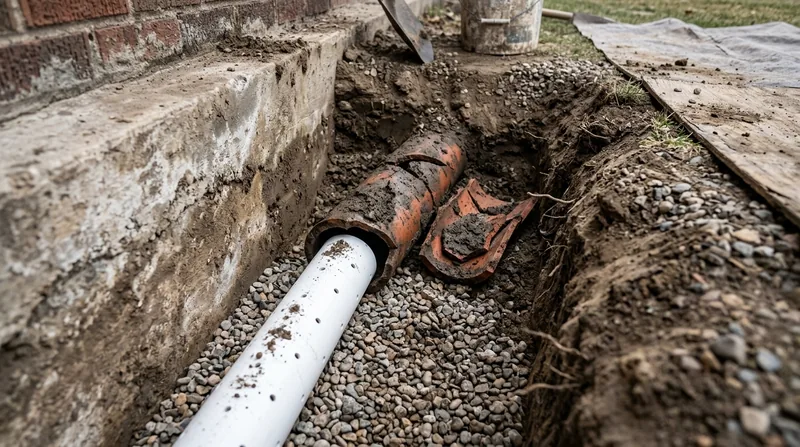




If you own an older home in downtown Brighton near the railroad tracks, there is a good chance your footing drain is original clay tile that has been failing for decades. In the 1950s to 1970s ranches on the east side, the block basements often sit on drain tile that has crushed under heavy clay soil, and in the newer subdivisions on the north and east edges, the poured basements rely on a perimeter drain that can clog with silt after a few hard hailstorms. Drain Tile Repair & Replacement in Brighton is the work of finding where that buried line has failed and restoring the path water needs to take away from your footing. Brighton sits at about 5,000 feet on heavy glacial clay that swells when wet and shrinks in dry summers, and the South Platte bottomlands add sandy river alluvium that shifts under a foundation. When spring snowmelt from the foothills and summer thunderstorms push water against the walls, a failed drain tile turns a dry basement into a wet one fast. We handle the camera inspection, targeted excavation, and modern PVC replacement that get the drainage working again. You can read more about our full basement waterproofing approach before you call.
Why Drain Tile Repair Matters in Brighton's Clay Soil and Older Downtown Blocks
Brighton's building stock tells the story of its drain tile problems. The 1900s to 1940s brick and frame houses in the downtown blocks near the railroad often still run on partial stone or block cellars with original clay tile footing drains that have collapsed or root-bound. The 1950s to 1970s ranches east of downtown have block basements, many partly finished, where a clogged perimeter drain lets hydrostatic pressure push water through the wall joints. The 1990s to 2020s subdivisions on the north and east edges have poured full basements, often left unfinished, with walkouts where the lots slope toward the drainage ditches. Heavy clay holds water against the footing long after the storm passes, and freeze-thaw cycles open cracks that let that water in.
- Clay tile footing drains from the early 1900s crack, offset, and fill with silt, so they stop carrying water away from the footing.
- Tree roots from mature cottonwoods and elms invade the joints of older tile lines and choke the flow.
- Heavy clay soil swells against the foundation and increases hydrostatic pressure when the water table rises after snowmelt.
- Walkout lots that slope toward the drainage ditches send surface water straight back to the foundation if the drain tile is not working.
- Original sump basins in 1970s ranches are often undersized for the volume that a modern thunderstorm delivers.
When the drain tile is failing, no amount of patching on the inside wall will stop the water. The line itself has to be restored or replaced.
Key info: A homeowner on North Main in downtown Brighton had a wet basement every spring for years. The original clay tile was crushed under the driveway slab. We ran a camera, found the break, and replaced the run with PVC, which ended the annual spring water. The City of Brighton's building department is the authority on any permit that applies to drainage work, and rules vary, so always verify before work starts.
For official guidance on permits and contractor licensing in Colorado, the City of Brighton website is the place to start.
How We Diagnose and Repair Drain Tile in Brighton Homes
We start by finding out what the drain tile is actually doing, not by guessing. A camera inspection through a cleanout or the sump basin shows whether the line is crushed, offset, root-bound, or simply silted shut. From there we decide between a targeted repair at the failure point and a full replacement of the run. On the older downtown houses, a targeted excavation at the break is often enough. On the 1990s and newer subdivisions with poured basements, a failed perimeter drain usually means replacing the full loop with perforated PVC wrapped in filter fabric and bedded in washed gravel.
- We camera-inspect the existing line and mark the depth and location of every failure.
- We excavate only where the line has failed, keeping the trench tight to protect driveways, patios, and mature trees.
- We remove the collapsed clay tile or crushed plastic and clear roots from the run.
- We install new perforated PVC with the correct fall toward the sump basin or discharge point.
- We bed the pipe in washed gravel and wrap it in filter fabric so clay silt cannot clog it again.
- We test the flow and reconnect the sump pump, check valve, and discharge line before backfilling.
Every repair ends with a flow test, so you see the water moving before we close the trench.
Key info: In the walkout subdivisions off Bridge Street, the lots slope toward the drainage ditches, and the drain tile has to discharge above the ditch flow line. We set the discharge and check valve so a summer thunderstorm cannot back water into the sump basin. If the pump is old or undersized, we pair the drain repair with a sump pump installation so the system works as a whole.
Drain Tile Repair Methods We Use in Brighton
The right method depends on the age of the house, the depth of the footing, and how much of the line has failed. Here is how the main approaches compare for Brighton conditions.
| Approach | Description | Best for |
|---|---|---|
| Targeted spot repair | Excavate at the break, replace the failed section with PVC, and reconnect the run. | Older downtown houses with one collapsed joint or root intrusion. |
| Full perimeter replacement | Remove the old tile loop and install new perforated PVC bedded in gravel and filter fabric. | 1950s to 1970s ranches where the block basement drain has failed along its length. |
| Interior perimeter drain | Cut a channel along the inside of the footing and lead water to a sump basin. | Finished basements where exterior excavation would destroy the landscaping. |
| Drain tile and sump upgrade | Replace the drain run and pair it with a correctly sized sump pump, check valve, and discharge line. | North and east side subdivisions with high water volume after storms. |
| Camera inspection only | Diagnostic run to locate failures before any digging begins. | Any home with a wet basement and no known drain history. |
We recommend the least invasive method that actually solves the water problem, and we tell you when a simple spot repair is enough.
Drain Tile Repair & Replacement Cost in Brighton: What to Expect
Most drain tile repairs in Brighton start at $750 for a targeted spot repair where the line is accessible and the failure is isolated. A full perimeter replacement on a 1950s ranch with a block basement runs higher because of the excavation length, the depth of the footing, and the cost of hauling out the old clay tile. Access is the biggest swing factor: a line under a driveway or a mature cottonwood costs more to reach than one under a lawn. The age of the house matters too, since original clay tile often comes out in pieces and the trench has to be re-bedded properly.
Getting two or three estimates is smart, and not just on price. Ask each contractor whether they will camera-inspect before quoting, whether the new line will be perforated PVC bedded in gravel and filter fabric, and whether the sump pump and discharge will be tested after the repair. A low bid that skips the camera inspection is a guess, not an estimate. You can see the full range of work on our pricing page before you call.
Finding a Drain Tile Repair Contractor Near Me in Brighton: What to Check
Hiring the right contractor matters more on drain tile than on most basement work, because the failure is buried and you will not see a bad installation until the next spring snowmelt. Start with licensed and insured status and ask for the certificate, not just a verbal yes. Get two or three written estimates that specify the camera inspection, the pipe material, the bedding, and the sump test. Ask for references from Brighton jobs, especially older downtown houses or 1970s ranches like yours. Check whether the work needs a permit from the local building department, since rules vary and any change to drainage or the sanitary connection of a sump discharge may require one.
Ask how the contractor will protect driveways, patios, and mature trees during excavation, and get the backfill and restoration scope in writing. A contractor who cannot explain the difference between a spot repair and a full replacement, or who quotes without looking at the line, is not the one you want. Reach out through our contact page to schedule a look at your drain tile.
Drain Tile Repair & Replacement in Brighton: Pricing Guide
| Service | Price | Details |
|---|---|---|
| Targeted spot repair | Starting at $750 | Camera locate, excavate at the break, replace the failed section with PVC, and test flow. |
| Full perimeter drain replacement | Starting at $3,500 | Remove old clay tile, install perforated PVC in gravel and filter fabric, reconnect sump. |
| Drain tile and sump upgrade | Starting at $4,800 | New drain run paired with a correctly sized sump pump, check valve, and discharge line. |
| Complex or large-scale job | On estimate | Deep footings, driveway or patio removal, or long runs need an on-site look before pricing. |
| Travel | Included | in Brighton and surrounding areas, no separate call-out or mileage fee |
| Estimate | Free | Response within 24h at (970) 714-2588, no obligation to book |
Indicative pricing, the exact cost depends on square footage, finish, and site access. Free personalized estimate within 24h at (970) 714-2588.


